
Did you know your cat’s ears are truly astounding? Not only can your fur baby’s ears help her detect prey using her whiskers — also known as ear furnishings — inside her ears, but they can detect frequencies as high as 64,000 Hz. For comparison, humans can only detect frequencies as high as around 20,000 Hz, which means your cat’s hearing is a little more than three times better than yours.
Just like humans, cats are susceptible to developing ear infections and other ear-related issues. (Fortunately for our feline friends, instances of ear infections are relatively uncommon.) Unfortunately, ear mites are considered common — and they’re highly contagious. If you’ve been frantically searching “mites cat ears,” or “dirty cat ears vs. ear mites,” you’re in the right place. Does your cat have ear mites? We’ll teach you how to tell.

What are ear mites?
Otodectes cynotis mites, a mouthful of a scientific name for such microscopic parasites, make their home in the ear canal and occasionally the skin’s surface. While fleas and ticks are visible to the naked eye, ear mites aren’t always as easy for us to spot.
These irritating arthropods love to nest in your cat’s ear canals, but they can also find homes on other beloved domestic companions, such as dogs, ferrets, and rabbits. Ear mites feed on ear wax and sebum, the main ingredient that makes up skin oil. (There’s no accounting for taste.) Once mites lay their eggs, they only require around four days to hatch. Three weeks later, these pests will reach adulthood and be able to breed — you guessed it — more ear mites. Yuck!

Symptoms of ear mites in cats
If you’ve noticed tiny white bumps inside your cat’s ears, you may wonder if your fur baby has acne. While cats can suffer from the same skin condition that plagued us throughout high school, it’s usually found on their chins.
Luckily, it’s easy to figure out if your cat has ear mites once you know what to look for. Depending on the severity of your cat’s ear mite infestation, you may notice everything from the aforementioned white bumps to dark material inside the ear. (It usually looks like coffee grounds.) In extreme cases, your cat’s ears may even become filled with pus. Other symptoms to keep an eye out for include:
- Scratching her ears excessively
- Frequently shaking her head
- Inflamed, red, or discolored ears
- Drooping ears
- Ear discharge with a foul odor
If you notice any of these symptoms, you may be convinced your cat has ear mites. Not so fast! You should take your furry companion to the vet. While the symptoms point to ear mites as the culprit, an allergic reaction, yeast infection, or bacterial infection caused by illness or injury could be the cause of her suspicious symptoms. As always, it’s better to be safe than sorry when you’re dealing with your cat’s health.
How to treat ear mites in cats
We have some good news, and we have some bad news. While ear mites aren’t a life-threatening condition for your beloved fur baby, they can cause painful irritation and itching. Even worse, leaving ear mites untreated can lead to nasty bacterial infections. Most bacterial infections respond well to antibiotics, but infections in the ear canal can also result in a ruptured eardrum, partial deafness, or even total deafness.
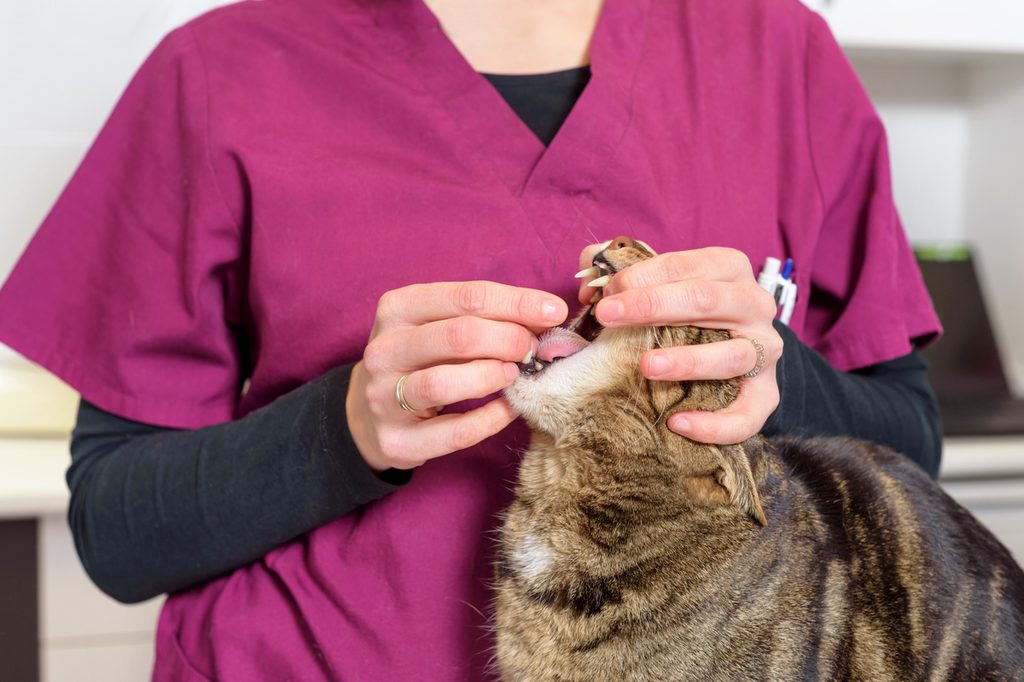
Once your veterinarian has confirmed ear mites are responsible for your cat’s symptoms, they can begin treatment. Milder cases of ear mites may only require a thorough cleaning and a topical treatment, such as a miticide, an insecticide used specifically for ear mites, or an antiparasitic drug like Ivermectin.
With that said, your cat’s treatment will be more complex if the infestation has caused a severe infection. Swelling of the inner ear can impact your cat’s sense of balance, and it can even cause nausea. And, if her nausea is severe, she could also be dehydrated. In this case, your cat’s vet will probably administer IV fluids, an antiemetic, and an antibiotic to treat the underlying cause of infection, in addition to topical treatments designed to kill the ear mites.

Can ear mites spread from animal to animal?
You probably don’t want to hear this, but ear mites can spread rapidly after exposure to an infested animal or location. Miss Mittens may be an indoor cat, but if your friend brings her infested puppy for a visit, your feline friend is likely to contract ear mites, too. And contrary to popular belief, ear mites actually are zoonotic. A curious veterinarian successfully implanted ear mites from a cat’s ear into his own ear. Afterward, this tenacious vet endured severe itching and temporary hearing loss.
(We love research as much as anybody, but that’s taking it a little too far for our taste.)
If your cat begins obsessively scratching her ears or shaking her head, a quick trip to the vet is in order, especially if she’s recently spent time around other animals or in locations frequented by other animals. Ear mites won’t seriously harm your cat, but there’s no reason your fur baby should have to suffer the itching, burning, muffled hearing, and potential for hearing loss that accompanies an ear mite infestation.