Although some breeds are more adept at learning new skills than others, dogs are well-known for their ability to learn and respond to commands. Cats, on the other hand… well, almost every cat person has a funny story or two about the times their fur baby makes direct eye contact while swatting a glass off the coffee table. And this is all while her frustrated cat mama yells, “No, Miss Mittens! No!” All it takes is a quick internet search for “cats hearing” to discover that her ears probably work just fine. In fact, cats can hear sounds as high as 64,000 Hz, which is three times higher than our 12,000-15,000 Hz hearing range. But do cats listen to us? Do cats recognize their owner when they speak? Let’s find out.
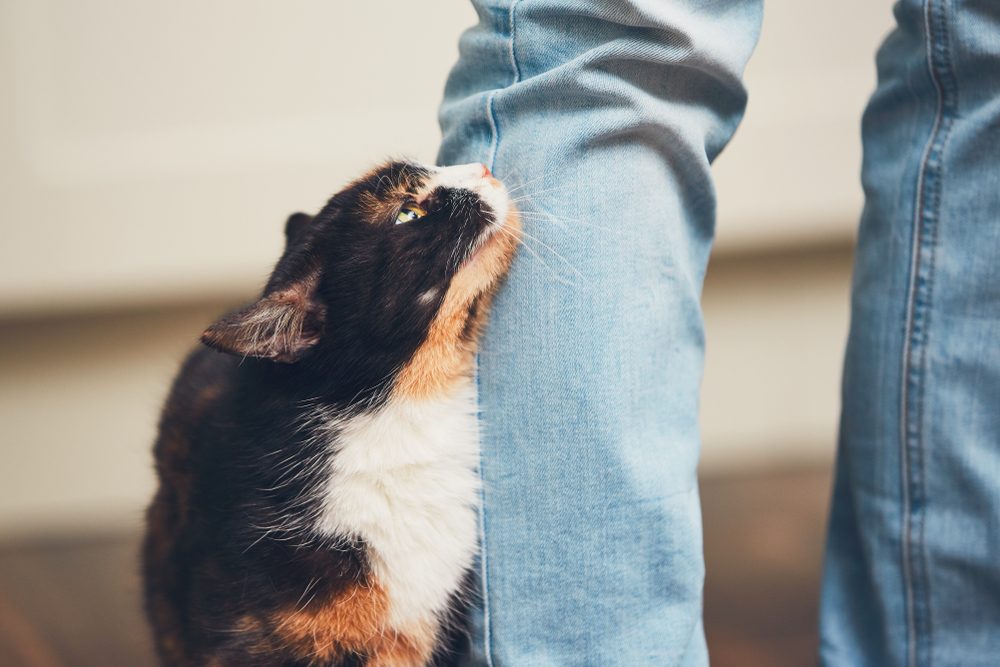
Is your cat ignoring you?
According to a recent study published in Animal Cognition, the answer is: Maybe not. French researcher Charlotte de Mouzon says, “We found that when cats heard their owners using a high-pitched voice, they reacted more than when they heard their owner speaking normally to another human adult.” In other words, using what’s colloquially known as baby talk is more likely to yield results if you want your cat to pay attention to you. (Scientists use a less cutesy term: cat-directed speech.)
How did researchers stumble onto this fascinating discovery? Not without difficulty. While most dogs respond well to observation, cats tend to become so anxious it dampens their reactions. In fact, researchers were so concerned the cats may not respond normally at all. Thankfully, the frisky felines participating did react, although not necessarily in the way researchers initially expected. Dr. de Mouzon goes on to elaborate: “Their reactions were very subtle. It could be just moving an ear or turning the head towards the speaker, or even freezing what they were doing.”
Does cat-directed speech work for everyone?
The study included a small group of test subjects consisting of 16 cats whose ages ranged from 8 months to 2 years old. But they weren’t just ordinary cats; the subjects belonged to National Veterinary School students from Alfort, France, says Christa Lesté-Lasserre of New Scientist. Interestingly, researchers discovered that cats respond well to cat-directed speech, AKA “baby talk,” but only when their owners speak to them. When strangers addressed the cats using cat-directed speech, the cats entirely ignored the speakers.
While de Mouzon postulates that the lack of response may be because the cats were all kept exclusively indoors and didn’t associate with strangers, she ultimately says the study proves that cats are “sensitive and communicative,” which is something pet parents already know in their hearts.
Final takeaway
The next time your cat appears to be ignoring you, remember that she’s most likely listening to every word you say — she just may not be interested in what you’re telling her. Try speaking in a higher pitch, using short words with elongated vowels, and offering your fur baby a treat. Chances are, she knows exactly what that word means.