
As described by the California Department of Social Services, “Assistance animals are individually trained to perform tasks for people with disabilities, such as: guiding people who are blind (guide dogs), alerting people who are deaf (signal dogs), and alerting people who have seizures, etc. (service dogs).” Registered service animals are protected under the Americans With Disabilities Act, which allows them to accompany their person in all public spaces. They are also exempt from any pet restrictions when it comes to housing, as are Emotional Support Animals — or ESAs.
ESAs, including therapy dogs and comfort animals, are not considered true service dogs, though. Title II and III of the Americans With Disabilities Act describe service animals as those who “have been specifically trained to perform a task for the person with a disability” (via ADA National Network).
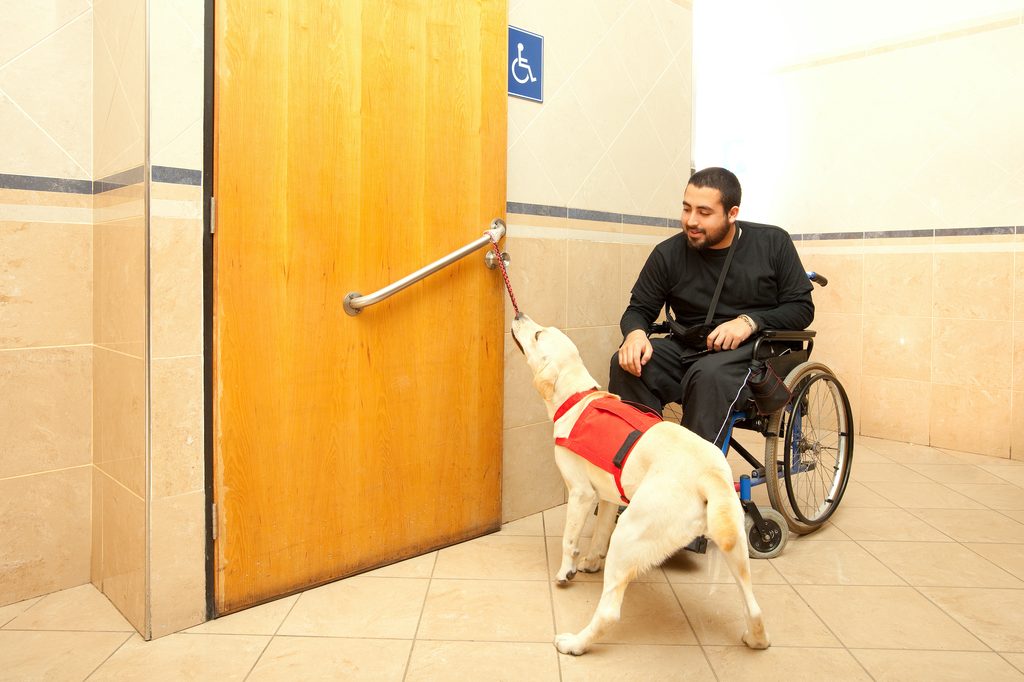
What types of service dogs are there?
Even though Emotional Support Animals are not true service dogs, there are many other kinds of licensed services that dogs can provide. These animals are highly trained and specialized in what they do, which gives their owners more confidence and independence in their lives.
Guide dog
A guide dog — or seeing-eye dog — is trained to help blind or visually impaired people navigate their surroundings. These dogs will usually be wearing a special harness with handles for their owner to hold as they walk together. According to United Disability Services Foundation, this helps the dog show their owner through feeling when to start, stop, or turn. Like many other service animals, guide dogs may also communicate through touch, like nudges or nose taps.
Hearing dog
These talented dogs help heating impaired people respond to sounds they would otherwise not know of, like doorbells, smoke alarms, or their names. Outside the home, notes the American Kennel Club, a hearing dog can also alert their owners to oncoming encounters, like people or passing cars.
Alert dog
Though their exact detection skills vary by individual, an alert dog is trained to detect and alert their person of a substance that could be harmful to their health. There are diabetic alert dogs who can detect glucose, gluten alert dogs, and even seizure alert dogs. The list doesn’t end there, though!
Many of these dogs are also trained to contact help when needed, which is just one more example of their nearly endless talents. For example, allergy alert dogs often carry a person’s medical information, a list of allergies, and even an Epi-pen in case of emergency (via UDSF).
Service dog
There are many other services a licensed dog can perform, from mobility assistance (providing support for a person to hold onto as they stand) or psychiatric service to daily tasks around the home. These all help an individual with a disability find more confidence and independence, no matter what difference they otherwise face.
It’s important to remember that psychiatric service dogs are different from therapy dogs or Emotional Support Animals. These service dogs are trained to deescalate a number of emotional events, from PTSD flashbacks to depressive episodes.

How do I qualify for a service dog — what are the requirements?
If you’re curious whether you or a loved one qualify for a service dog, you must qualify as having a disability as defined by the ADA: “a physical or mental impairment that substantially limits one or more major life activities, a person who has a history or record of such an impairment, or a person who is perceived by others as having such an impairment.” The act itself does not list specific conditions.
If your condition or disability can benefit from the assistance of a service animal, you can visit a healthcare provider to see whether you can get approval.
What do I need to do to qualify for a service animal?
As Mental Health America admits, “Qualifying for a service dog is simple. Actually getting one is a bit harder.” In order to qualify for service dog companionship, you’ll need to visit a doctor who can verify your physical or mental limitations and confirm whether a dog would help you. This will require a physical exam and some conversation with your doctor, so be ready with some examples and research to support your request.
Once approved, the real search begins. If you’re looking for an Emotional Support Animal, though, you won’t need to find a specifically trained dog — any canine companion counts! For true service dogs, though, you’ll want to locate and contact a service dog provider or nonprofit. Waiting for your perfect match can be the most time-consuming part of the process, so be patient!
Despite the long wait and even longer adjustment period, taking the time to register for and meet a service dog can be a life-changing decision for everyone involved. Not only does a talented canine get a home and a job to keep them feeling fulfilled, but their owner can gain a sense of independence and joy that only a dog can bring.