There are so many reasons to love the warmer months of the year, especially if you’re fond of getting outside with your furry friend. One thing pet parents aren’t so fond of, though, is the ticks that thrive as the weather heats up. Luckily, tick prevention is easy to find, and tick removal isn’t terribly complicated — you don’t even need to visit your vet to take care of it. With the right tools and a strong stomach, you can have your pet’s skin clean and creature-free in a matter of minutes.
By the time you’re done reading, you’ll have all the knowledge you need to remove a tick from your dog or cat. Hopefully, you won’t need to utilize this skill, but it’s an important one for pet parents to have nonetheless.
Here’s what you need to know.

What tools do I need to gather to remove a tick from my dog or cat?
As tempted as you might be to use the closest object to scrape or pluck the tick off your kitten or pup, you could do more harm than good this way. Instead, take a moment to gather the appropriate tools — plus a treat for your fur baby, of course. A few minutes won’t put your pet at any extra risk for tick-borne diseases; it takes 24 to 48 hours for transmission of Lyme disease to begin in dogs, according to the American Kennel Club. Taking your time to make sure the tick is removed fully and as painlessly as possible is a much safer option than removing it incorrectly.
For the best chance of full, correct removal of ticks in your pet’s fur, you’ll want the following tools (courtesy of Republic Veterinary Hospital):
- fine-tipped tweezers (not the wider-tipped ones used for human hair removal) or a tick removal hook
- rubbing alcohol
- disposable gloves
- small jar or bag to store the tick
- magnifying glass or similar tool (optional)

Tick removal for pets
Dr. Jason Nicholas and the team at Preventative Vet remind readers to stay away from home remedies. Using heat or lighting a match to get the bug to detach is almost always ineffective, and it’s also incredibly dangerous for your pet. Alternatively, smothering the tick with Vaseline or another material is unlikely to detach them, even if it does kill them.
Instead, here’s how you can remove a tick from your dog or cat:
Tick removal with tweezers
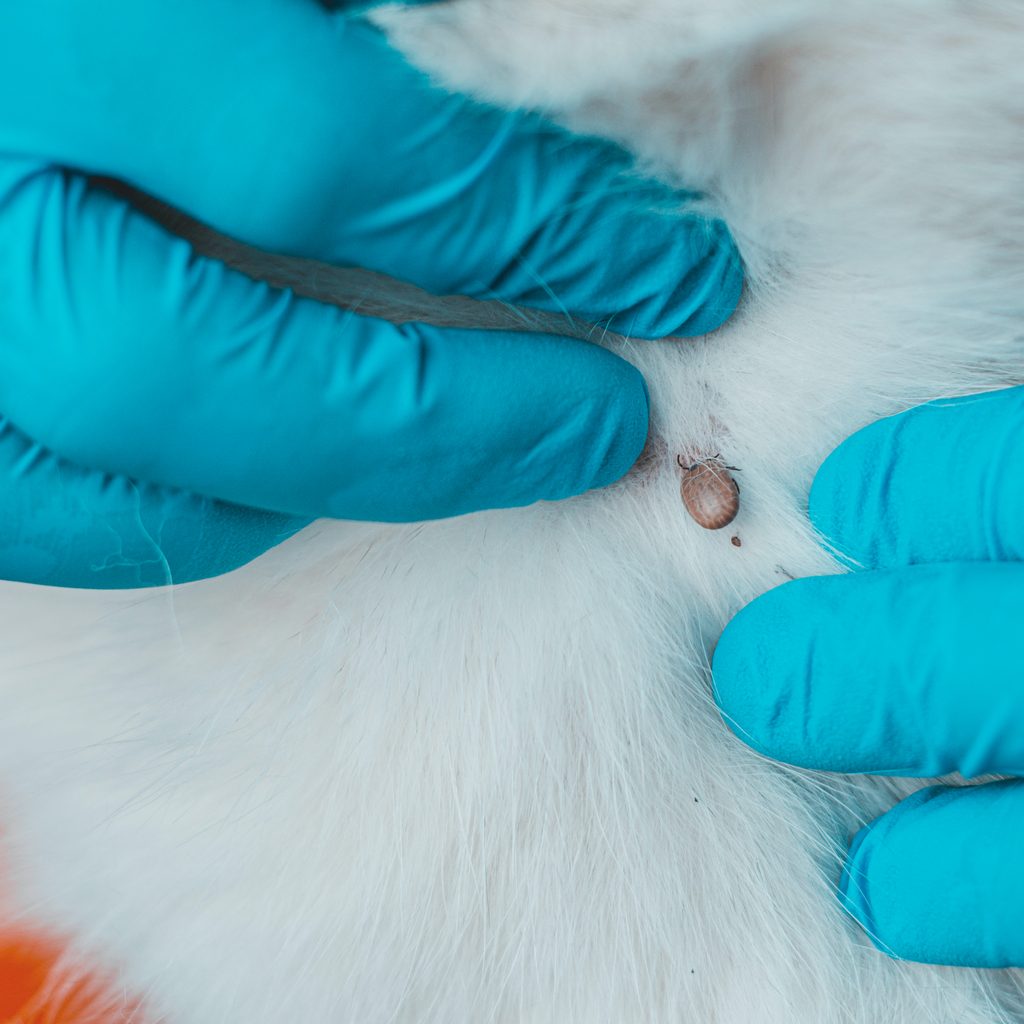
Tick removal is a two-handed job; you’ll want to use one hand to spread your pet’s fur so you can grab the tick instead of any hairs, and you’ll use the other hand to hold the tweezers. When you grasp the tick, make sure to hold it as close to the skin as possible. The American Kennel Club suggests removing the bug by pulling “straight upwards, in a slow, steady motion” to avoid leaving any pieces embedded in the skin. This part can take a minute — don’t rush! By pulling too hard, you’re more likely to have the tick break, leaving behind a piece embedded in your pet’s skin.
If you’re not totally sure that you’ve removed the entire tick, there’s no harm in taking a precautionary trip to the vet. They’ll have more advanced tools to remove the smallest of pieces, and they can double-check that your buddy is protected against tick-borne diseases.
Tick removal with a tick removal hook
If you choose to use a tick removal hook instead of fine-tipped tweezers, the process could be even quicker. It’s important to familiarize yourself with how your tick removal tool works, though, because there are a few different kinds.
The Tick Twister — a popular tweezer-like tool to twist ticks off the skin — is the only tool that does not advise pulling straight up. Instead, you will grip the tick as close to the skin as possible by sliding it between the prongs, then make a slow, twisting motion until it detaches.
Other tick removal tools have a flat, forked tip that removes ticks in a part-lifting, part-scooping motion. Just like with tweezers, you’ll want to use a slow and smooth upward motion so that you don’t break the tick.
No matter what tool you choose to remove the invading creature, make sure to store the tick safely in a jar, baggie, or container. You’ll also want to cleanse the bite area with soap and water, rubbing alcohol, or an antiseptic wipe to ward off any germs.
How do I know if the tick is fully removed?
The only sure way to know for sure if you’ve removed the entire tick is to give it a good look. A fully removed tick will be alive and intact, so it will likely wave its legs around, even just a little. If any piece of the head or mouth is still in the skin, it may or may not be visible. Luckily, a leftover piece is not likely to cause a serious problem (via Animal Medical Hospital). The worst it can do is cause a localized infection, which is still worth keeping an eye out for.
Whether or not your dog has encountered ticks before, it’s important to keep your pup as protected as possible. There are many veterinarian-approved tick prevention methods for sale by prescription or over-the-counter, so it’s worth doing some research to decide what works best for you and your fur baby. When in doubt, why not ask your vet?