Caring for your pet snake – especially if you’re new to it – can be downright daunting and intriguing. There are simply way too many unknown factors about their nature. You never know what they’re truly thinking. You never could figure out what motivations reside behind a simple tilt, or slither, or tongue-flick.
Anyone who’s seen snakes knows they frequently flick their tongues out of their mouths, even if just for a few brief seconds. But why do they do it? Do snakes smell with their tongues? The answers may surprise you.
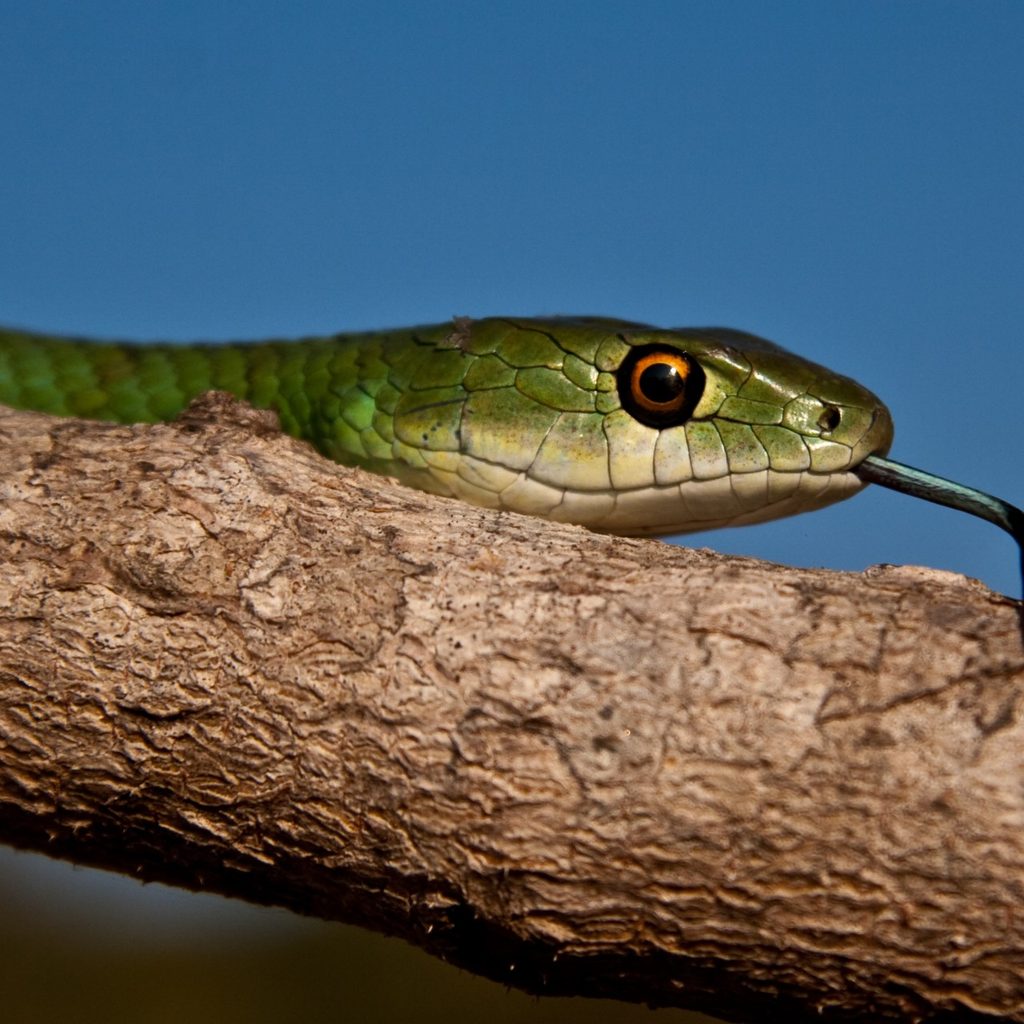
Why do snakes flick their tongues?
When you think of your typical tongue and its purposes, you might list eating or talking. Some animals use their tongues to catch prey or clean themselves. Can the same be said of a snake’s tongue? And why is it forked?
The tongue flicks of a snake are unique to that animal. People have long wondered what purpose a snake’s tongue flick serves. Aristotle was fascinated by snakes and pondered the reason for tongue flicks; he hypothesized that it served as a taste organ. In the 17th century, a widely held belief was that, like other reptiles such as chameleons, snakes caught insects with their tongues. This was never observed, however. Italian astronomer Giovanni Hodierna thought snake tongues were used to clean dirt out of their nostrils. A long-held myth is that the snake tongue is the source of snake venom. This idea was perpetuated in various Shakespearean works. But autopsies of snakes performed since the Renaissance have disproved that theory, too.
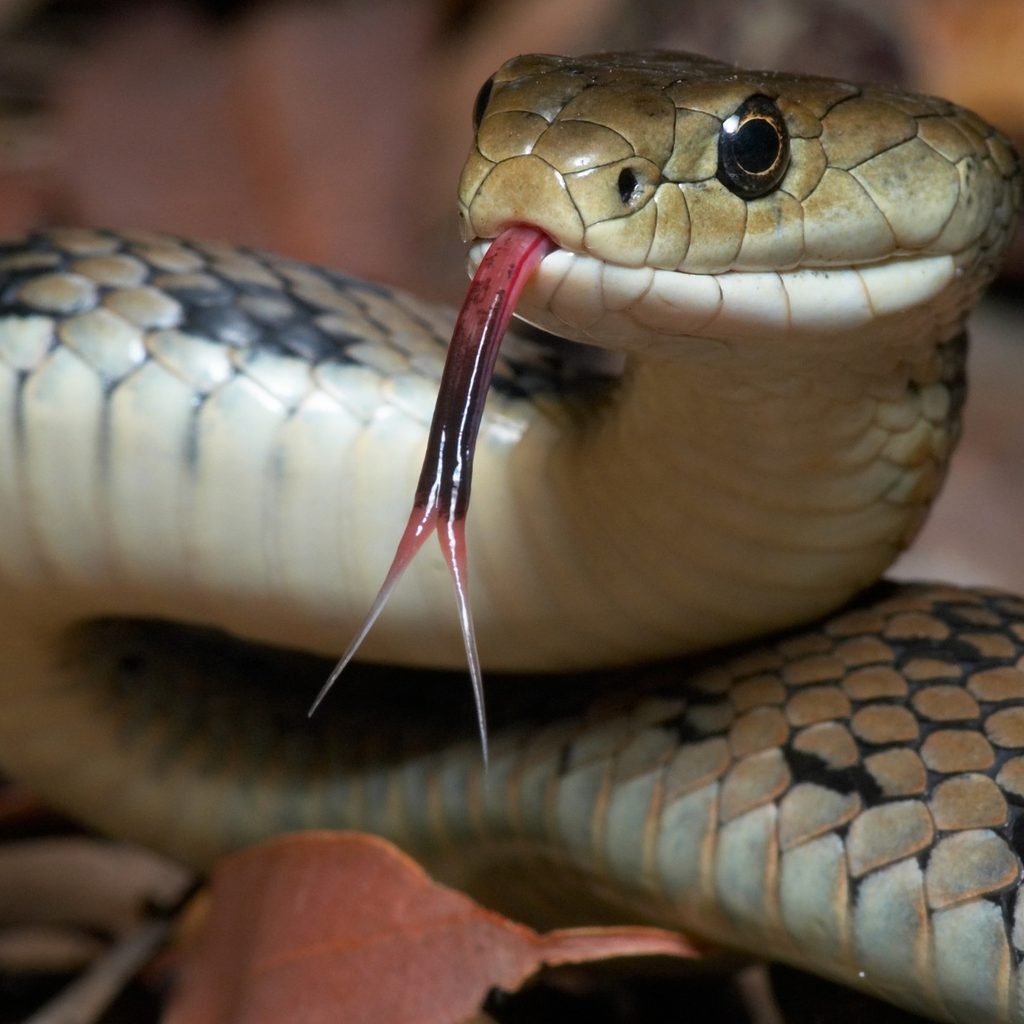
Why do snakes stick their tongues out?
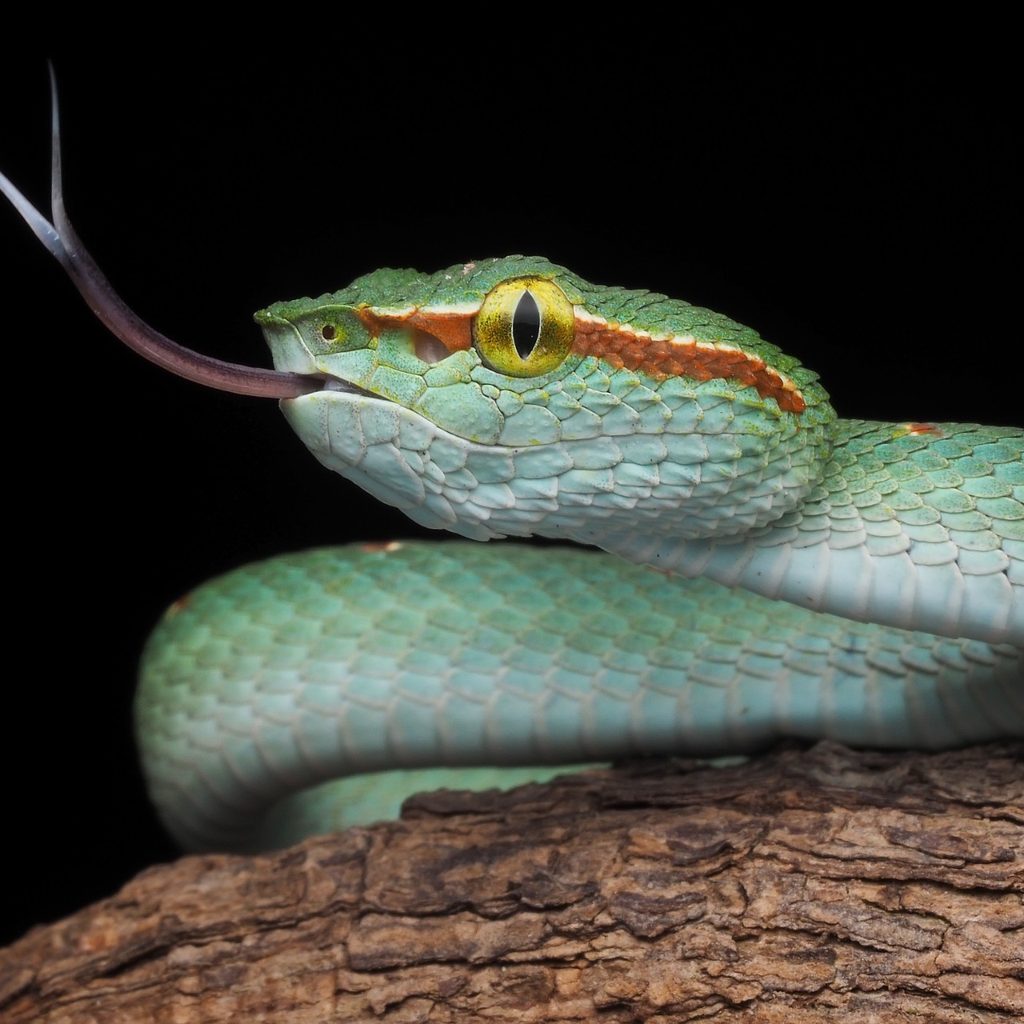
You see her dart her tongue out and retract it quickly. Then again. And again. What’s she doing? Quite simply, snakes usually stick their tongues out to get a better smell. That’s it! Unlike humans, who use our eyes as a way to take in most of the world, snakes don’t rely on sight for everything. In fact, many serpents have poor vision and struggle to see clearly. They also lack ears and, therefore, the acute hearing found in people and most pets (though they can “hear” through feeling vibrations). Therefore, many snakes rely on their sense of smell to find prey and mates and to check out their surroundings. While snakes do, of course, have nostrils, these small openings need a little help from their mouths. Their special tongue greatly increases a snake’s ability to smell what’s around them.
There are two different types of tongue flicks, one for retrieving particles from the air and the other from the ground. These pheromone particles are deposited in the mouth from the tongue and then taken by the two-lobed Jacobson’s Organ. Next, they are processed as electrical sensations and sent to the brain. The Jacobson’s Organ, also known as the vomeronasal organ, is also found in other reptiles. The length of the tongue allows a snake to detect particles in 100 times more air than the simple downward extension of the tongue would permit. The act of flicking the tongue stirs up the air, creating vortices that hover around the snake’s tongue letting them inspect more air for pheromones.
A fork for a reason
Now we know why a snake flicks their tongue so often — to decode details about their environment. However, that doesn’t answer the question of why a snake’s tongue is forked. It is relevant, though. The forked tongue allows a snake to gather information from two places simultaneously. It allows snakes to create a sort of chemical gradient, so that they can navigate the world around them using pheromones. The reasoning behind a snake’s forked tongue was proven in the 1930s by a German scientist named Herman Kahmann, who observed that snakes who had the forked portion of their tongue removed were much less able to follow trails.
More recent studies have shown that pheromones tracked are not just those of potential prey, but also those of potential mates. In fact, male snakes generally have longer, more deeply forked tongues than females. This is so males can pursue potential female partners, which is the normal method of snake courtship. Snakes follow trails by detecting the trail with each fork of their tongue, and adjusting the direction in which their body is moving accordingly. For example, if one fork does not fall within the trail, the snake will move in the opposite direction.
When will my snake use her tongue for smelling?
There are several reasons why a snake might use her tongue for smell.
Feeding: You can see your snake flick her tongue a lot more often around feeding time, especially if you give her something alive to chase. In fact, in the wild, snakes hunt using this special smell technique to follow prey through scent trails. They smell the ground or air in one area and then follow that same aroma, constantly testing to keep track of it. While your pet no longer needs perfect hunting instincts, she still has the habit built in.
Mating: It’s also possible that some snakes, especially males, use this scenting to find a mate. When another snake is close by, you might see your pet give a couple of tongue flicks. She’s essentially tasting him through the air and determining if he’d make a good partner.
Getting to know you: There’s one other thing snakes might be sniffing out: you. While your animal will get to know you eventually, your smell might have belonged to a predator or a threat to her wild ancestors (or possibly her cousins). When you first bring her home, she might think to still avoid your smell. Don’t worry, though. Many snakes are trainable and will learn that your smell means food and free time, not danger.
Now you know probably more than you wanted to about a snake’s long, forked tongue and why it flicks. Use this knowledge to impress a curious snake fan, or let the facts be a simple introduction to the world of herpetology — the study of reptiles.