
From scenes of snoot booping and dog yoga to adorable, husky howls, there’s no shortage of dog videos to get caught up in. Clips of pets reacting to their reflections are some of the fun ones that make the rounds on social media and they’ve raised a lot of questions about dogs and mirrors.
Some pets have basically no response whatsoever, while others go absolutely bonkers when they see their second self. There’s no doubt that our furry friends see and react to something in the looking glass, but do dogs recognize themselves in mirrors?
The jury is technically still out on this one, but research is starting to reveal more about the minds of our canine companions. Either way, it’s certainly entertaining to watch your pup discover their own reflection — or whatever they think it is. Sniffing, head tilts, and even frantic barking are common reactions to that mysterious creature in the mirror, but what does it all mean?
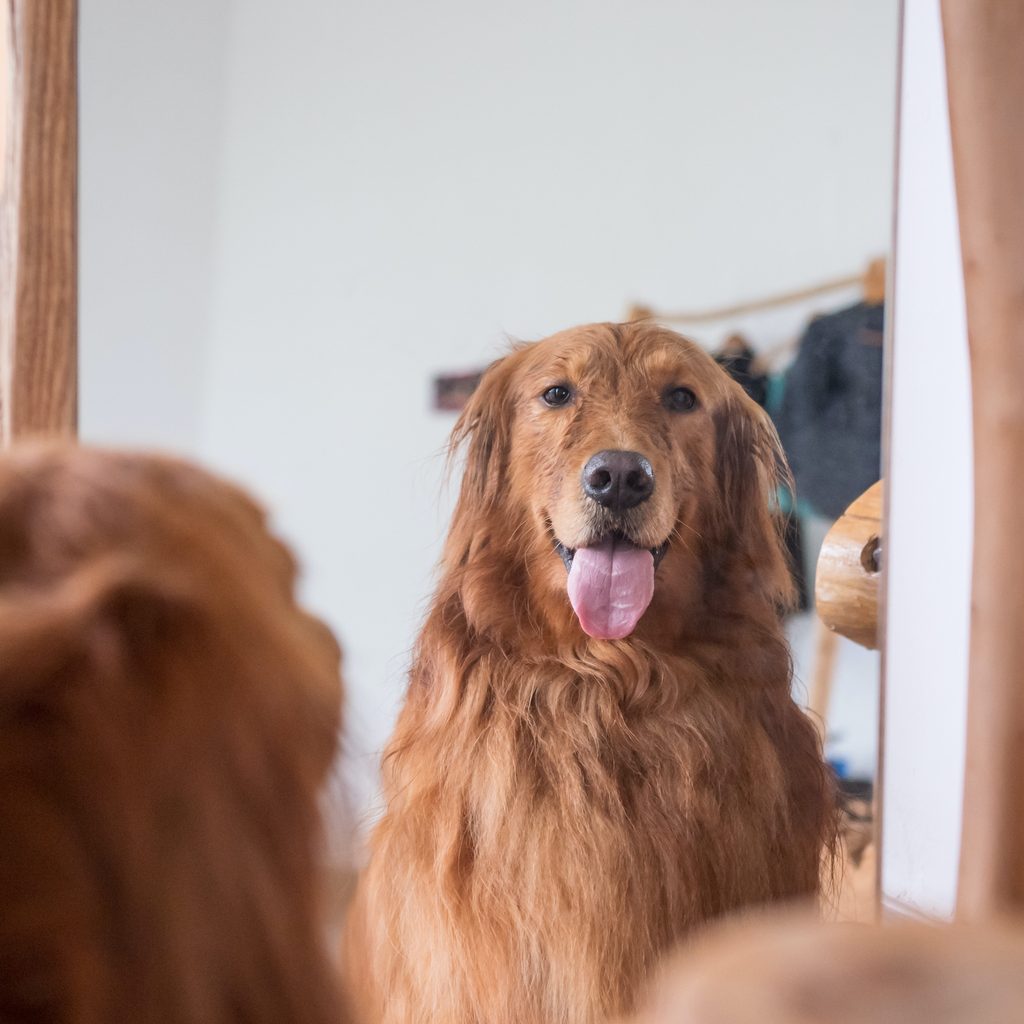
Do dogs recognize themselves in mirrors? Here’s what experts have to say
The Mirror Test is a classic — yet controversial — scientific experiment to help researchers determine the level of self-awareness in animals. In this experiment, explains Affinity Pet Care, scientists will place a mark (something like paint or marker) on an area of the body that the animal can see only by looking in the mirror. If a test subject examines the mark on their own body (by pawing or scratching, for example) after only seeing it in the mirror, researchers can conclude they have self-recognition. According to many sources, including the American Kennel Club (AKC), dogs fail this test.
Today, canine behaviorists have more exact and appropriate ways to test for self-awareness. For example, even though dogs fail the mirror test, they pass a more recent “body as obstacle” test with flying colors. In this experiment shared by the AKC, a dog is tasked to pick up a toy and hand it to its owner. Here’s the catch: the toy was sometimes attached to the mat that the dog is sitting on. In an effort to see whether the dog can recognize their own body as the obstacle, researchers wanted to see if pups would get off the mat in order to move the toy. And they did!
Since dogs know where their body is in space, they may have more self-recognition than we realize. Still, although some dogs react to their own reflection, research has not yet confirmed that dogs recognize the reflection as another dog — let alone as themselves.
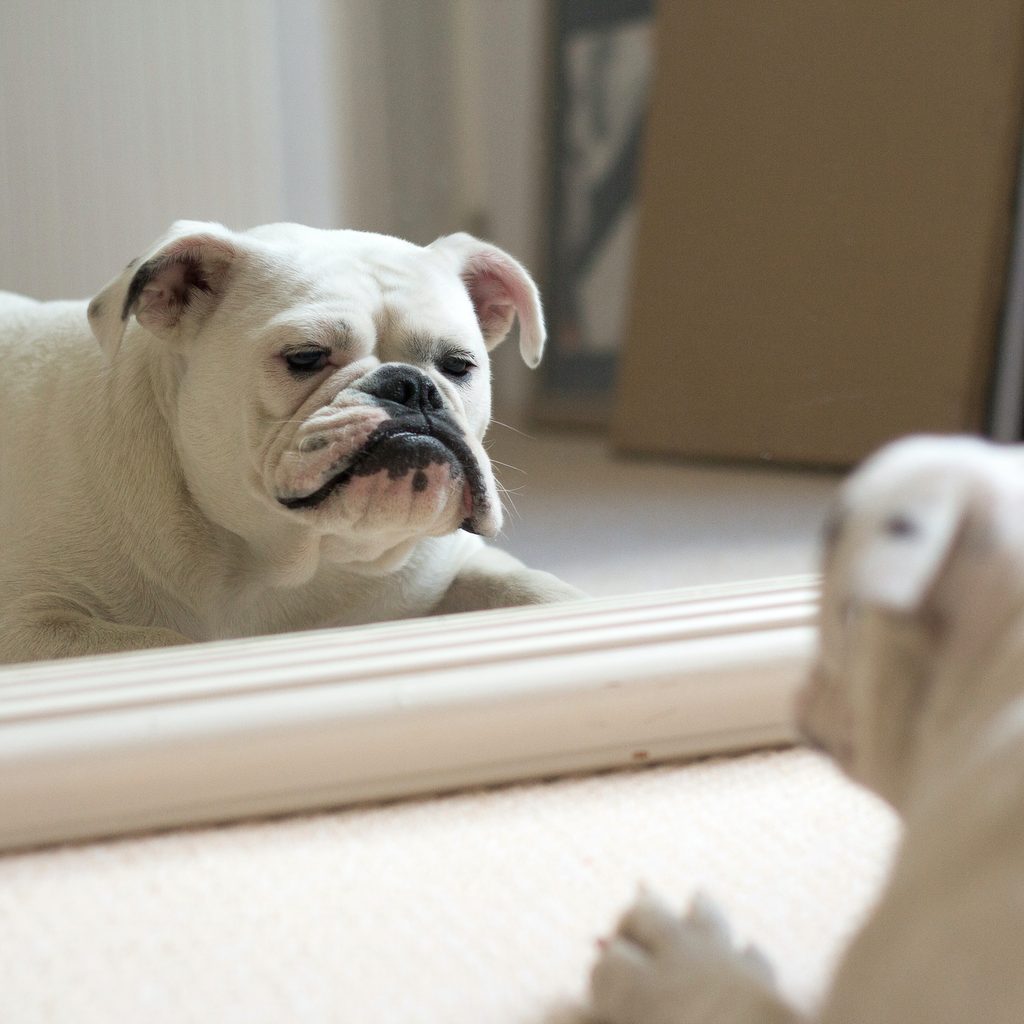
Why do dogs look into mirrors if they can’t recognize themselves?
So if dogs aren’t seeing themselves in the mirrors, what are they seeing?
Odds are, they use mirrors as a tool just like we do. Tiffani Howell and Pauleen Bennett of the Anthrozoology Research Group conducted a more recent mirror study to make it clear whether dogs process what they see in mirrors. Specifically, do they understand the reflective properties of these household items?
In one study in which a pup’s owner was only visible through a reflection, only seven out of 40 dogs turned around to their owner after spotting them in the mirror. Their second experiment required dogs to find a bowl of treats that were only visible through a mirror. The results of this study were equally unclear — 77% of dogs were able to find the food using reflections, though 41% of participants were still successful without the use of a mirror.
Overall, one may conclude that some dogs certainly do process the images they see in the mirror, while others do not.
Dog behavior researcher Julie Hecht brings another interesting phenomenon to attention. Though many dogs and puppies have a pretty big, albeit confusing, reaction to seeing a mirror for the first time, most of these pups learn to quickly dismiss this strange creature in the wall. This is called habituation. Over time, as your dog interacts with their reflection with no real-world consequences, their brain will slowly learn that the reaction is not truly worth the effort.
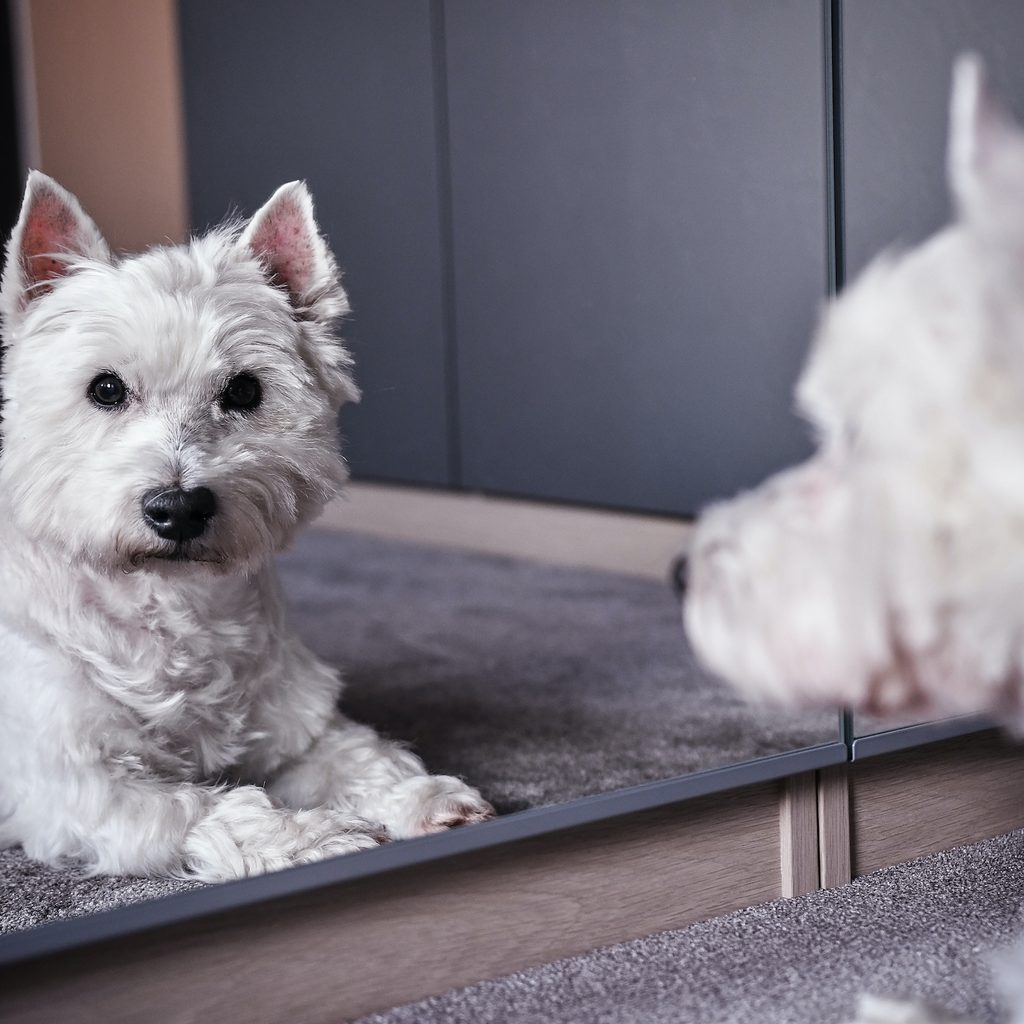
My dog doesn’t recognize his reflection — what does it mean?
If your dog only reacts to their reflection with a little riling up, or maybe not at all — don’t worry! Mirrors are by no means an essential tool for canine survival, and there is likely no concerning reason that your dog doesn’t quite “get” the concept of reflection.
Of course, you can always check in with your veterinarian if your furry friend’s behavior suddenly changes, or if you notice a decline in your dog’s vision or cognitive function. Otherwise, you can feel completely guilt-free for enjoying all of those hilarious moments, or even for catching them on camera.