
Love snakes or hate them, they’re fascinating creatures. Unlike other reptiles, snakes don’t have arms or legs. Yet, even without appendages, these slitherers can move across many different types of terrain, often very quickly. They can make their way up mountainsides and climb to the tops of trees. Some even leap and glide from branch to branch!
But have you ever wondered, “Can snakes swim?” — and which snakes can swim? Well, the answer, interestingly, is all of them.
And no, swimming ability doesn’t depend on whether a snake is venomous or not. Some swim partially submerged with only their heads above the water, and others with practically their entire bodies gliding on the surface.
The next question is, how do snakes swim without any limbs?
In the article below, we’ll discuss exactly how and why some of these serpents go for a dive and others ride the waves.
Snakes move in four ways
To understand how snakes can swim, you need to know how they move at all. A snake’s entire body is lined with muscle underneath its scales, and it uses those muscles and scales in combination to progress across the landscape. Here are the four ways snakes move.
Concertina method
In tight spaces, one might observe a snake using the concertina method to propel himself forward. It’s a bit like how an inchworm moves, actually. First, the snake anchors the rear of its body by pressing against the ground or an object. It then pushes forward with the rest of its body. Then it drops its head and sort of hangs onto the ground with its chin while skootching the rest of its body forward.
Rectilinear method
In this method, the snake creeps forward in a straight line. It’s a slow crawl, and the snake basically uses the broad scales on its stomach to clutch the earth and push itself forward.
Serpentine method
This is the kind of movement that you normally think of when you picture a snake slithering across the ground — wavy. The snake pushes off from a resting state from just about anything next it. It then uses momentum to stay in motion, undulating its body and using its belly scales to push itself forward.
Sidewinding
Snakes primarily use this type of motion when they’re on a surface that’s hard for their stomach scales to grip, such as mud or sand. The snake will throw its head forward and wriggle its body in the same direction. As its body moves, the snake throws its head forward yet again, so its motion continues.

How do snakes swim?
So far so good, but how exactly do snakes move their bodies through water?
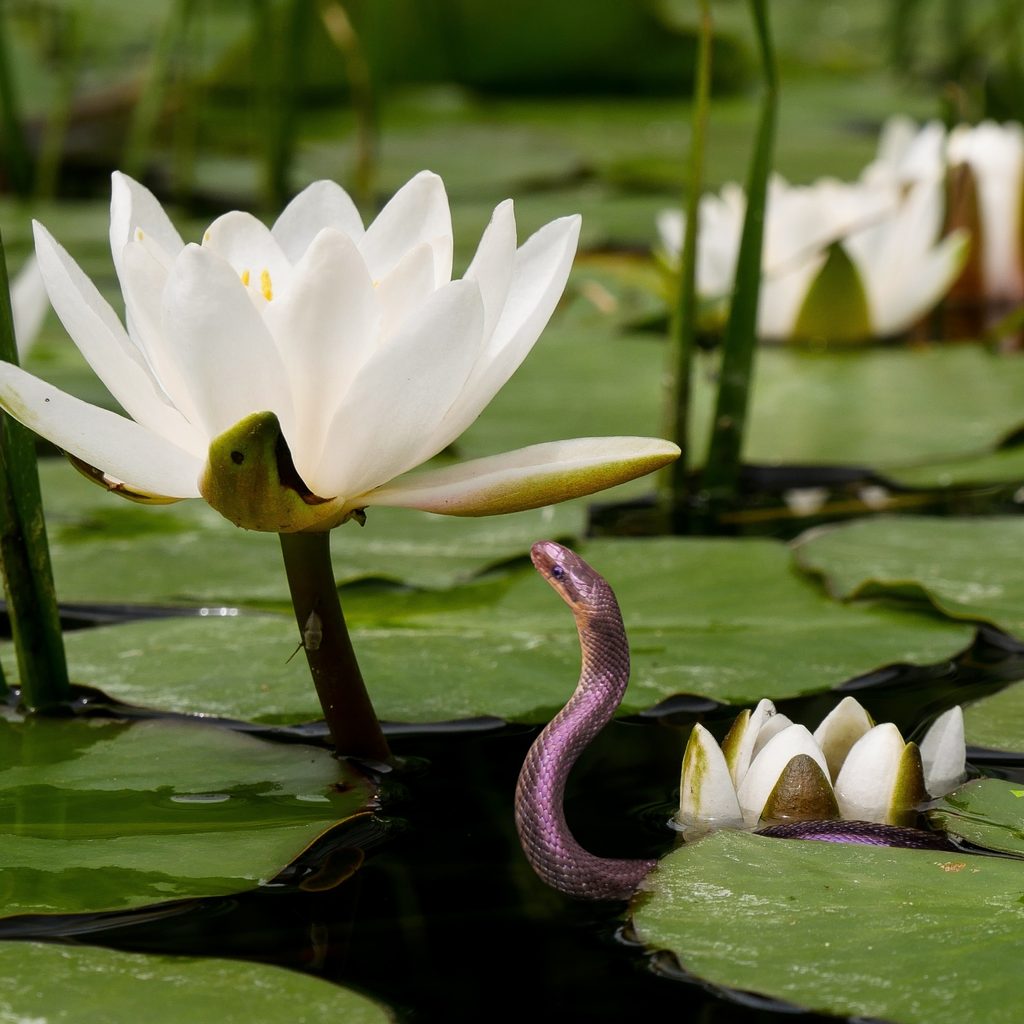
The answer is that snakes use nearly the same motions in water as they do on land. When you see a snake essentially bodysurfing across the top of the water, it’s most often using the serpentine method discussed above. That’s true whether on a pond, a lake, or the sea
The snake uses the surface tension of the water combined with its movement to stay afloat. When a snake undulates in the water, drawing what amounts to an “S” with its body, it applies force to the water behind it. That force propels the snake forward through the water.
Not all snakes swim as well as others
Although most snakes move quite well on land, the same cannot be said for moving in or across the water. Of course, certain snake species have adapted to an aquatic environment, such as sea snakes. These guys are expert swimmers. Certain freshwater snake species are also better swimmers than their mostly terrestrial counterparts.
Snakes that have adapted to a life near or in water have bodies that are a little more flattened, and some even have tails that may remind you of a paddle. Of course, this helps them dart forward and move faster and more efficiently than land-based snakes.
Additionally, some sea snakes are known to travel great distances, sometimes from island to island!
So, water is no barrier to snakes. All of them can swim using the same four movements that propel them over land (and trees and mountains) even without limbs. Some snakes skim and some submerge to get through water, but all of them can navigate this challenging part of their environment.


