Birds have been keeping humans company for about 4,000 years, ever since a flock of geese sounded the alarm when Rome was being attacked and saved the city. In 2017, more than 20 million birds were kept as pets in the United States. If their noisy nature has kept you from adding a feathered friend to your family, take another look. These are four quiet bird breeds that make amazing pets.
Canary

The canaries we know in captivity were domesticated from wild canaries originating in the Macaronesian Islands. As members of the finch family, they were first bred in captivity in the 17th century.
Today’s songbird is only 4-5 inches tall, but it’s a low-maintenance bird that doesn’t need a lot of attention. These greenish-yellow birds are mostly timid and don’t like to be handled. Because flight is an important part of their health and happiness, canaries need a large flight cage.
Canaries make pleasant chirping and whistling noises that are low in volume and not too shrill. Both males and females sing. Their average life expectancy is between nine to 10 years.
Finch
Another small bird known for its beautiful coloring and pleasant song is the finch. These birds are passerines, or perching birds, and do well in large flight cages or aviaries where they can fly from side to side.
Estrildid finches, such as the Gouldian finch, owl finch, and zebra finch, originated in Australia and are most commonly kept as pets. Their average lifespan is five to nine years.
Finches vocalize throughout the day, using low-volume chirps and tweets to communicate. They are happiest in pairs.
Cockatiel (budgie)
As the smallest member of the cockatoo family, cockatiels tend to vocalize in the early morning and evening hours. These docile birds spend the majority of their time sitting and preening. Although males are more likely to talk, they are also the noisiest. Their average life expectancy is 10-14 years.
Budgies can’t scream like a larger parrot; however, they do chirp, whistle, squawk, and cheep. These playful, happy birds are great communicators and will use their calls to get your attention, warn you, or let you know they need something.
Cockatiels are very social birds and enjoy spending time outside their cage on a perch. They also appreciate having a few toys to play with as well as a shallow bowl of warm water in which to take a bath.
Doves and Pigeons
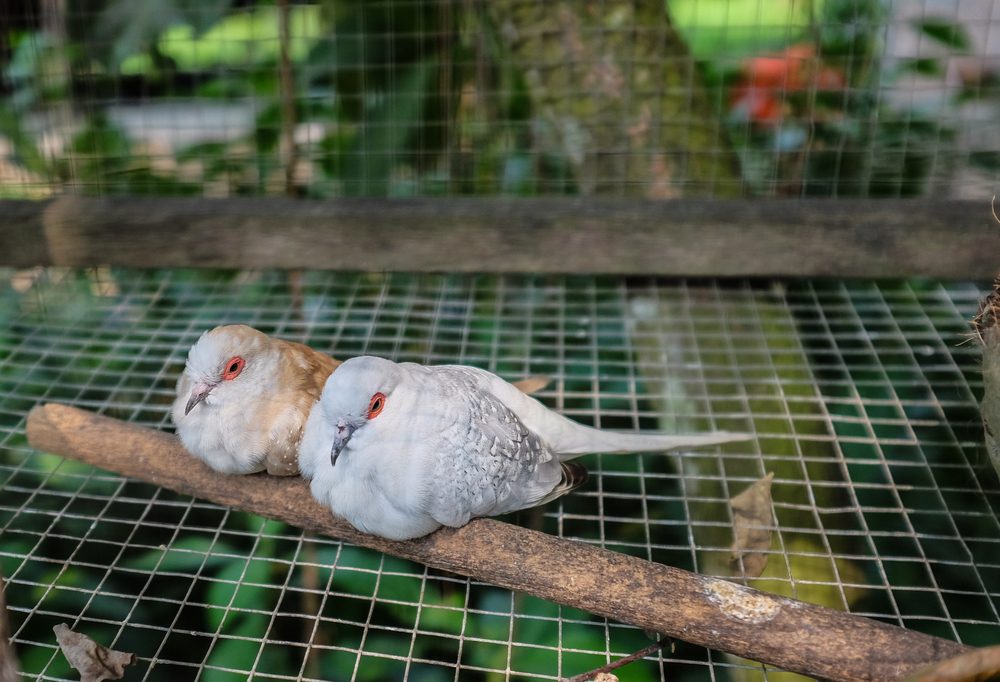
Pigeons and doves belong to the same family of birds consisting of more than 300 species. While both have large, round bodies, doves are typically smaller. Both make great pets.
Doves
Doves have been a symbol of peace and goodwill since the early 19th century. In addition to their quiet nature, they are attractive, easy to tame, inexpensive, and low-maintenance.
Although most think of doves as gray or white, today’s pets have been bred in a rainbow of colors, including tangerine, pied, and orange. Doves like to fly, so they need a larger cage where they can stretch their wings. They spend most of their time on the ground walking and need a water source where they can bathe.
Doves make a variety of cooing sounds and are very affectionate. Females are quieter than males. They are very social and do best when kept in pairs. They share the cage well with finches and have an average life expectancy of 10 years.
Pigeons
Another bird you may not have considered as a pet is the pigeon. Kings, fantails, tumblers, and homers are smart, gentle birds that do well in an outside aviary or inside in a large flight cage.
Pigeons have been around for 10,000 years, making an early appearance in Egyptian hieroglyphics. Thirty-two pigeons even received medals after World War II for their role in delivering important messages!
Like doves, pigeons coo to communicate with other pigeons and grunt when they are distressed. As pets, they are very low-maintenance with a life expectancy of 15 years. They are very social birds, so plan to keep a pair if you are unable to spend time with them every day.
Quiet is a relative term
No bird is completely quiet, and if they are, may be showing signs of distress or disease. All birds vocalize to some degree. That’s why it’s important to choose a bird that is compatible with your tolerance for noise as well as your need for companionship. With careful research, you’ll soon be one of the millions of U.S. households that enjoy the entertainment and companionship of a feathered friend.